Backpack vs Rucksack: Which One Should You Buy in 2026?
By admin | May 13, 2026 | Bags and wallets
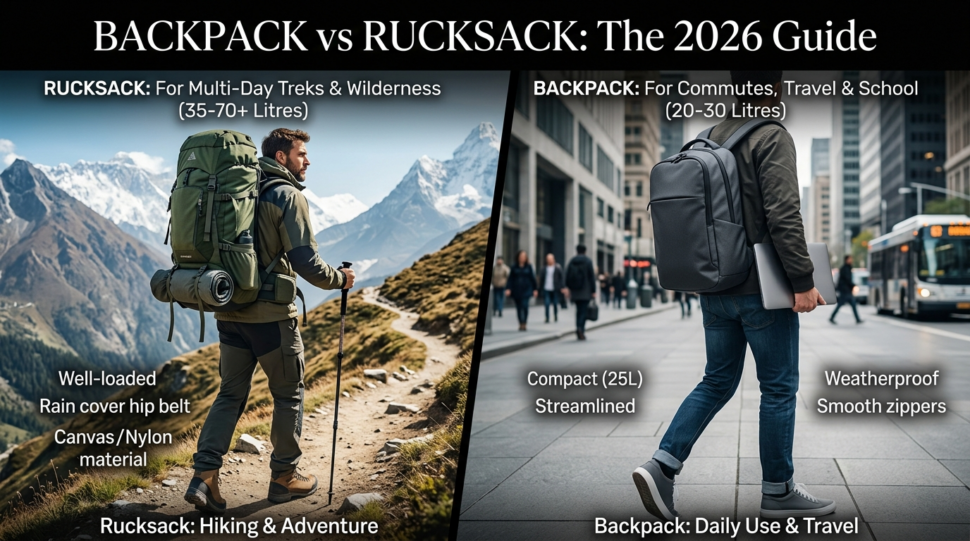
Probably you’ve always used the same words “backpack” and “rucksack” without knowing the difference. Most people have. However, when you’re standing in a store (or sifting through dozens of online choices), wondering which one you’re really going to purchase, the difference begins to become important.
Or are they the same? Mostly, yes. But not entirely.
But, more importantly, which one is suitable for your life in 2026?
This guide will clear up the backpack vs rucksack dilemma for you, whether you are climbing up a mountain trail, running down through a city, jumping through international flights, or simply need something sturdy for school. No padding or filler. Everything you need to make a savvy purchase.
Let’s get into it.
What Is a Backpack? (And What Makes It a Backpack?
A backpack is a bag that is attached to the back with two shoulder straps. That’s the simplest definition. In today’s context, though, “backpack” has come to mean all things from a light school bag to a technical travel pack to a sleek laptop backpack.
Most people refer to a “backpack” and are imagimagineng that it is for everyday, urban or casual wear. Consider school bags, gym bags, commuter bags and laptop bags. They are more prone to:
- A clean and streamlined exterior design
- Technology, documents, and other daily items are housed in organised interior compartments
- A wide range of lighter materials for non-rugged environments is available.
- Is comfortable to carry for brief periods of time.
In 2026, backpacks are extremely high-tech. Smart backpacks also feature USB charging ports, anti-theft zippers, RFID-safe pockets and even solar panels, making the everyday backpack more functional than ever.
What Is a Rucksack? (The Real Definition)
This is where it gets exciting.
The German word, rucksack, is made up of two words, Rücken (which means “back”) and Sack (which means “bag”). So literally a bag for your back. In British and European English, the term ‘rucksack’ is the common name for what Americans call a ‘backpack’. For all intents and purposes, they are the same object.
But these days, the word “rucksack” has a more specific definition when it comes to outdoor and adventure clothing. Today, when people talk about rucksacks, they are referring to a larger, more structured, frame-supported pack that is used for:
A long hike in, around, and out of town.Hike or trek for a long time.
- Multi-day camping trips
- Military & tactical use
- Difficult access to high loads over long distances
The right hiking pack should have an internal or external frame to distribute weight evenly, a hip belt to ease the weight off the shoulders, several access points, and waterproofing. Usually, capacities begin at 30 litres and can be over 70 litres for serious trips.
Although technically a backpack, not all backpacks can be considered rucksacks in the functional sense.
This is a comparison of backpacks and rucksacks.
So far, we’ve established what is what. Now, let’s look at the real-world distinctions.
1. Size and Capacity
This is a clear difference.
The usual capacity for backpacks is from 10 to 30 litres. The typical school/commuter backpack is around 20-25 litres. A laptop bag could be 18-22 litres. These are intended for a laptop, some books, a water bottle, gym clothes, etc.
Rucksacks begin at the end of backpacks. Day-hiking Backpacks normally range between 25 and 35 litres. Multi-day trekking rucksacks range in size from 40 to 65 litres. Expedition rucksacks can carry 70-100 litres. These backpacks are the ones that serious hikers and trekkers would use to carry a tent, sleeping bag, cooking equipment, food and clothing for a week in the wilderness.
For a day or less, use a backpack to carry your gear. Beyond or overnight rucksack.
2. Frame and Structure
One of the most important functional differences between a backpack and a rucksack is internal structure.
The majority of backpacks used for daily wear and tear have padded back panels, and possibly a stiff foam or plastic frame sheet that will help maintain the shape of the backpack and help protect the laptop. They are not designed to carry heavy loads, however.
A hiker’s backpack is designed for weight-bearing. The internal frame rucksacks feature aluminium stays or a moulded frame to direct the weight of a heavy pack from the shoulder to the hip. This is essential if you have to carry 15-20 kg for 1 or more hours. It will otherwise lead to fast fatigue in the shoulder and back.
Rucksack hip belts are not just for looks; they serve a purpose. With a well-fitted rucksack, about 70-80% of the weight of the rucksack is carried on the hips, making heavy carrying far more comfortable.
If you’re carrying heavy loads or for extended hauls, a well-framed rucksack is essential.
3. Organisation and Compartments
It is here that most of the modern laptop backpacks and urban daypacks excel in comparison to most rucksacks.
Backpacks are usually well organised and have specific pockets for everything, from padded laptop sleeves to card pockets and pen holders on the front to water bottle side pockets, anti-theft pockets that are hidden, and key clips. There’s a place for everything.
Generally, rucksacks focus their attention on volume rather than organisation. They also come with a large main compartment that can be packed freely, a lid pocket for easy access items, and hip belt pockets for snack items and other small essentials. It’s a good compromise for outdoor sporting, but if you need to work on your back at the office, the rucksack isn’t the best option.
4. Comfort Over Time
If you are travelling for only a few hours, a day at school, or a short trip, a commute, virtually any well-padded backpack will do.
For long hikes with full hiking days, airport sprints, and backpacking across a number of cities, the issue of comfort is a serious engineering question.
Rucksacks are specially designed for the comfort of long carrying. The adjustable torso length, contoured shoulder straps, load lifter straps, sternum straps and ventilated back panels combine to make a heavy rucksack seem almost manageable for 8-10 hours of walking.
Backpacks just weren’t made to this degree of use. Carrying 20 kg in a standard backpack and walking extensively for a day can be a very unpleasant and even dangerous situation.
5. Weather Resistance
It is another aspect in which rucksacks for outdoor activities outperform.
The materials are generally nylon or polyester and are water-resistant, and more than half of them have a built-in waterproof cover that is a separate rain cover that fits over the whole pack when it rains.
There are plenty of urban backpacks to choose from. Waterproof backpacks are common in 2026, but most are designed for commuting or travelling and won’t hold up to hours of heavy rain. When the weather is unpredictable, it’s much safer to use a rucksack fitted with an appropriate rain cover.
6. Style and Aesthetics
Let’s face it, this matters too.
Backpacks are more stylish in the urban setting. The top backpacks of 2026 are sleek, modern, and look as good in the coffee shop as on the hiking trail. Materials vary from traditional nylon to high-quality leather to sleek canvas. When your work attire is important, either during a meeting or while you’re in the city, the backpack is the style-savvy option.
Rucksacks are designed for function, not style. They have external straps and hip belts, and they are not a professional-looking garment. They’re tools for the outdoors and style, well, not so much.
Various kinds of backpacks and rucksacks are worth knowing.
Knowing what sort of big backpacks there are and the different rucksack styles helps to determine exactly what you need.
Daypack
A light day pack (15-25 litres capacity) for day trips, school or commuting. Simple organisation, no frame. The most popular category.
Laptop Backpack
Designed around carrying tech. Padded compartments, cable management and anti-theft features. The ultimate carry to take to the city.
Travel Backpack
Designed as a carry-on case. Typically packed between 35 and 45 litres, using a clamshell for easy packing. The ideal travel backpack for 2026 is both functional and enduring, while also being easy to pack and unpack.
Hiking Rucksack
Technical outdoor pack that has a frame, hip belt, and load-distribution system. Designed for hiking and backpacking.
Trekking / Expedition Rucksack
50+ litres. Whether it’s a multi-day camping trip, a mountaineering or a long-distance trail, serious gear is for serious adventures.
Tactical / Military Rucksack
Heavy-duty construction; MOLLE webbing for attachments; designed to be extremely durable. Commonly used for the military or for rugged outdoor adventures.
Smart Backpack
The 2026 evolution built-in USB charging, anti-theft zippers, RFID protection, and GPS tracking pockets. Technology and everyday carry combine.
Which One Should You Buy? A Simple Decision Guide
Try to ask yourselves the following 3 questions:
1. What are you using it for?
- School, travelling, commuting, gym → backpack
- A rucksack should be used for hiking, camping, multi day trips.
2. How much are you carrying?
- Over 10 kg, over 30 litres → Backpack
- If you are over 10kg and more than 30 litres, then you use a rucksack.
3. For how long will you be using it?
- Take a hike up in the hills (a few hours max) → Backpack
- A rucksack should be used for full days or several days. A full day or several days = Rucksack
If your responses were a mixture, you travel a lot and do some day hikes, then use a hybrid travel pack (35-40 litres) which combines both.
What to Look for When Buying in 2026
If you’re looking for a backpack or rucksack, here are the characteristics that set the good from the great:
Ergonomics first. An ergonomic hip belt (for rucksacks), back vent and padded shoulder straps are huge in terms of comfort of carrying. Never compromise here.
Material quality. Check for rip-stop nylon, Cordura fabric or weatherproof polyester. These materials resist deterioration easily and can be used outdoors day after day without rapid wear.
Zippers and hardware. YKK zippers are the best! Low-cost zippers are likely to give out prematurely, which can happen at any moment.
Capacity vs actual need. There is no point in going bigger than you need to be. If you tend to overpack, a smaller bag enforces packing discipline and relieves your back!
RFID protection. If you’re travelling with a backpack, a hidden pocket where you can store your passport and cards is a very valuable safety feature, particularly for backpacks.
Warranty and brand reputation. In 2026, the top backpack brands are here to support their products. Check for brands that provide repair or replacement warranties.
The Most Frequently Asked Questions (FAQs)
Q1. How is a backpack different from a rucksack?
A1. Backpack and rucksack are synonymous, in common parlance, a bag or pack on the back held by two shoulder straps. In practice, however, a backpack is used for smaller, urban, everyday bags (20–30L), and a rucksack is used for larger, outdoor grade bags (35L+) that have frames and hip belts, dedicated to hiking and trekking.
Q2. Which is better, a backpack or a rucksack?
A2. There is no clear winner between the two! A backpack is ideal for commuting in the city, school, travelling, and carrying your laptop. A rucksack is more suited to heavy-duty items such as hiking, camping and carrying heavy loads for a long distance. This will all depend on what you wish to use it for.
Q3. What does “rucksack” mean in English?
A3. The name comes from the German words “back” (Rücken) and “bag” (Sack), referring to the back of the rucksack. It is just backpack in British and European English. Outdoor: specifically, a large pack with a frame that is used for hiking or long journeys.
Q4. Do you want a front pocket wallet that is too big?
A4. A hiking rucksack generally will have an internal aluminium frame or frame sheet, padded hip belt, load lifter straps, sternum strap, and a ventilated back panel. These structural components help to balance the weight over your hips and torso, but not all on your shoulders.
Q5. Which is the best backpack for travel in 2026?
A5. In 2026, the ideal travel backpack would conform to airline carry-on restrictions (which are usually 40L to 45L), open in a clamshell fashion for quick packing and unpacking, have RFID-protected pockets for storing your phone and other electronics, be made of durable and tough materials to withstand the weather, and have a comfortable belt for longer trips through airports and cities.
Q6. Which backpack is best for hiking?
A6. If you are hiking, use a rucksack with an internal frame and padded hip belt, with a capacity of 25-35L for day hiking or 40-65L for multi-day hikes, a rain cover, and several attachment points on the exterior. Adjustability (fit & torso length) is as important as brand & price.
Q7. Are big backpacks practical for everyday use?
A7. Backpacks larger than 30L can be useful for school, gym or travel, but are heavy to carry every day. For everyday use, 20-25L is just enough space to carry the important items without the weight of a full backpack.
The Final Word
The real question is what do you need for your life, so that’s the backpack vs rucksack debate.
When you’re on the go and need a laptop, water bottle, and a commute in one place, a smart, well-designed backpack has it all and looks good at the same time.
When exploring mountain trails, multi-day camping trips, or anywhere where you’re willing to carry a hefty load for a long distance, the right rucksack can be the difference between a good time and a bad time.
Know your use. Buy accordingly. No matter what you ultimately decide to do, make sure it is a quality bag; a good bag that is carried every day will cost you a fortune.
Shop Rays Creations for Quality Backpacks and Bags.
We believe that what you carry should be as capable as you are at Rays Creations. From a stylish everyday backpack to a tough hiking rucksack to a travel-ready pack for 2026 adventures, we have a backpack for you.
Shop all our bags today and discover the bag that fits your life, not your pockets.
Your stay is a lot for you. Make it count.
No Comments yet!